
Running a Sex Offender Check in Sumter County
The Alabama Law Enforcement Agency Sex Offender Registry is the main public source for Sumter County. Local law enforcement registers, photographs, and fingerprints a person, then submits updates to ALEA. ALEA says the public system updates daily in real time from those local submissions. The Sumter County sheriff is the local fallback when an address appears stale or a registration concern needs review.
Start with a name when identity is known. For community awareness, search by Sumter County, city or town, ZIP code, or geographic radius. Use NSOPW when a search may cross Alabama's borders. Results should be read as a point-in-time public notice, not as a complete file of every detail held by law enforcement.
Sumter Registry Update Chain
The update path has two custodians. Local law enforcement collects registration data and verifies changes. ALEA manages the state repository and publishes fields authorized for public release. A delay or stale address should be reported to law enforcement instead of tested through direct contact with the person listed.
The ALEA registry FAQ and rules page explains the state role and daily update practice.
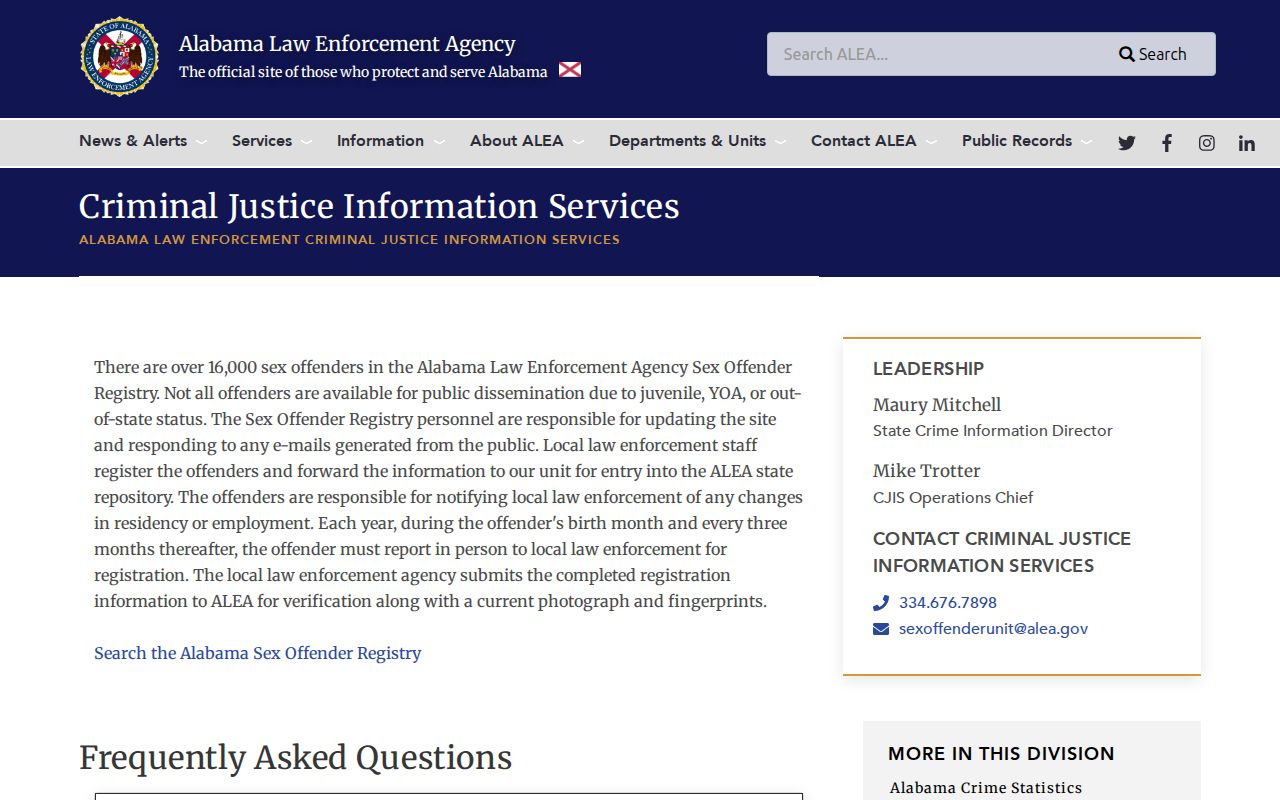
The official explanation shows why a Sumter County correction begins locally while public display is managed at the state level.
Searching the ALEA Sex Offender Registry
The official search interface is the Alabama Community Information Center. The research session could not safely inspect every live dropdown or button because the interface returned a web-application challenge. The search criteria below come from Ala. Code § 15-20A-8 and should guide the query without inventing screen controls.
- Open the ALEA service link and proceed to the Community Information Center search.
- Choose a name search or use a place field such as Sumter County, city or town, ZIP code, or geographic radius.
- Compare the result list carefully using the public identity and location fields.
- Open the relevant profile, read status and qualifying-offense details, and note the source date or current display.
- Use the sheriff contact when an address appears stale; use NSOPW when the search must include other states.
| Search Criterion | Type | Required | Source Note |
|---|---|---|---|
| Name | Identity search | One available route | Authorized by § 15-20A-8. |
| City or Town | Place search | Optional route | Useful for Livingston, York, Cuba, or another Alabama place. |
| County | Place search | Optional route | Select Sumter County for the local view. |
| ZIP Code | Place search | Optional route | Authorized public criterion. |
| Geographic Radius | Area search | Optional route | Authorized by statute; exact live values were not confirmed. |
Sumter ALEA Registry Access
ALEA publishes a service page that directs the public to the state registry. It is the better starting point than a copied vendor bookmark because it preserves the agency context and legal notices. Searchers should not assume that a third-party list is current or complete.
The official ALEA registry service link routes users to Alabama's public search.
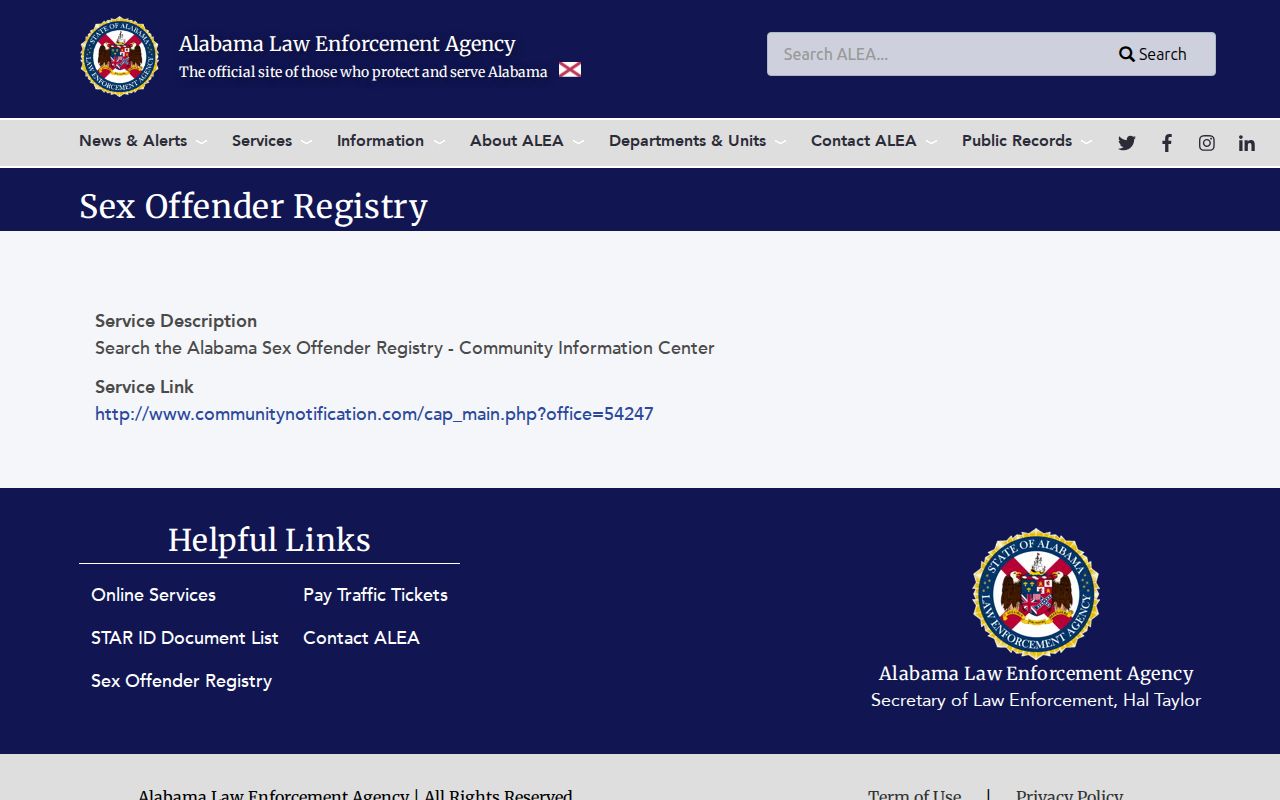
The state service page connects Sumter County searches to the official publication channel rather than an unofficial directory.
What a Registry Profile Shows
Alabama law separates public profile fields from the broader information held for registration. A public Sumter County result can identify the registrant, residence, visible status, vehicles, and qualifying offense history. It should not reveal protected victim data or private identifiers.
| Name and Aliases | Name, aliases, nicknames, and ethnic or tribal names may be public. |
|---|---|
| Photo and Description | A current photograph and physical description may appear. |
| Addresses | Residence and, where the statute permits, school and employer addresses. |
| Vehicles | Plate and description for land, air, or water vehicles. |
| Offense History | Sex-offense criminal history plus statutory description or text of qualifying offenses. |
| Registration Status | Status information can include an absconded designation. |
| Fields Kept Private | Nonconviction arrests, Social Security number, travel document numbers, victim identity, and internet identifiers are not publicly disseminated under § 15-20A-8. |
Note: The public profile is narrower than the full law-enforcement registration record and should not be read as the complete file.
Missing Sumter Registry Profiles
A missing public result is not proof that no registration exists. ALEA notes that juvenile, Youthful Offender, out-of-state, and other statutory-status limits can affect public dissemination. Spelling and geography can also change the result. Try known aliases and place fields, then use the national layer for another state.
If the issue is a stale Sumter County address or suspected noncompliance, use the official Sumter sheriff page and call (205) 652-7984 or (205) 652-2841. The state county directory is a second local contact source, while the Sumter County government site provides the county fallback. No separate registration counter, direct unit number, or published hours was located. Do not confront the person at the listed address.
Registration Requirements and Levels in Alabama
Alabama does not use a simple public Tier I, Tier II, and Tier III chart for ordinary adult registration. The relevant model is based on adult status, homelessness, and juvenile provisions. Adult reporting is generally in person each quarter for life under § 15-20A-10. ALEA describes a birth-month report followed by reporting every three months.
| Alabama Category | Duration | Reporting Pattern |
|---|---|---|
| Adult registrant | Generally life | In person quarterly, plus short deadlines for reportable changes |
| Adult experiencing homelessness | As the Act applies | Weekly reporting requirement |
| Certain serious juvenile adjudications at age 14 or older | Lifetime, with possible petition after 25 years from release | Governed by § 15-20A-28 |
| Other juvenile registration | Generally 10 years | Governed by § 15-20A-28 |
The adult acknowledgment form also lists a $10 fee paid to each registering agency at quarterly registration and for a new residence. Noncompliance is described as a Class C felony with a $250 assessment.
The form groups quarterly cycles by birth month: January, April, July, and October; February, May, August, and November; or March, June, September, and December. It includes initial lines for 34 duties and restrictions, plus names, signatures, dates, and registering-officer fields. The form documents the duty that Sumter County law enforcement administers. It is not a public search profile, and its broader registration fields should not be assumed to appear online.
Sumter County Registry Distance Rules
Ala. Code § 15-20A-11 generally bars an adult registrant from living within 2,000 feet of a school, childcare facility, or resident camp, subject to the law's exact exceptions. Alabama measures the distance in a straight line from property boundary to property boundary. A map estimate or driving route is not the statutory method.
Because the rule turns on legal boundaries and statutory exceptions, address questions should go to the registering agency. A public map result can support awareness, but it does not replace the agency's compliance review.
Sumter Registry and NSOPW
The Alabama registry is the direct state source for Sumter County submissions. The U.S. Department of Justice National Sex Offender Public Website provides a federated cross-state search. NSOPW is useful when a person has moved, an address sits near a state line, or the likely state is uncertain. It does not replace a local report about a stale Sumter County address.
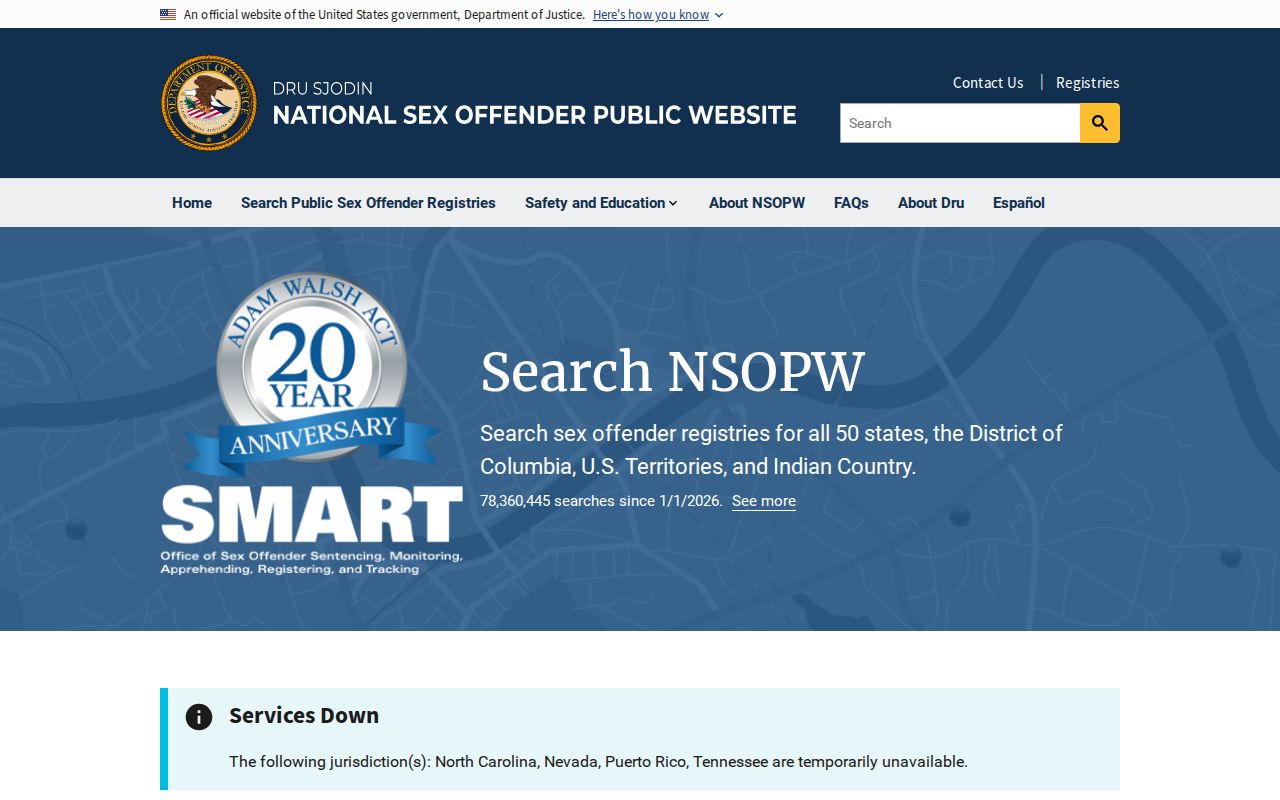
The national interface adds geographic reach while Alabama law and local submissions still control the Sumter County profile.
Sumter Community Notification
Community notification under § 15-20A-21 varies with municipality size and statutory category. In unincorporated or smaller communities, sheriff-led notice may reach residences within 2,000 feet and schools or childcare facilities within three miles. The exact duty depends on the statute and the registration category, so the rule should not be reduced to one universal mailing radius.
Notification supports personal and family safety planning. It does not authorize direct monitoring, threats, or attempts to enforce the law. Questions about a Sumter County notice or an apparent violation should be sent to law enforcement.
The local process is part of a wider reporting chain. A registering agency supplies a current photograph and fingerprints and sends reportable changes to ALEA. The state then updates the public system from local submissions. When a residence changes, the public display depends on that chain rather than an observer's own claim. Giving the sheriff the profile details and reason for concern lets the proper office check the record without putting neighbors or the reported address at risk.
Lawful Use and Community Notification
The public registry exists for awareness and lawful safety decisions. Verify a profile through the official system and use the listed status with care. If information seems wrong, preserve the public details and contact the Sumter County sheriff or ALEA. Local law enforcement checks compliance, and ALEA publishes the update that the local agency submits.
Misuse is a crime: Ala. Code § 15-20A-8 prohibits using registry information to unlawfully injure, harass, or commit a crime against a registrant or reported address. Report concerns to law enforcement and do not confront the person.
A careful Sumter County sex offender check distinguishes public notice from a license for vigilantism. The safest response to stale data or possible noncompliance is a direct report to the sheriff.
Public vehicle, address, status, and offense fields can help a household recognize the profile that matches the search. They should be checked against the current official entry before any safety plan is changed. Protected victim identities, internet identifiers, travel document numbers, and nonconviction arrest data are outside the public disclosure list, so their absence is a legal limit rather than a search flaw.